
Office Address

Q3-111, SAIF Zone, P.O. Box 120740, Sharjah, United Arab Emirates

Contact Number

Tel: +971 6 5578157
Fax: +971 6 5578158

Email Address

info@wavesme.com

Categories
Industry Insights

Why GPS Stops Working Indoors and How to Fix It

GPS is something most people take for granted, until it stops working. Step inside a large building, an underground facility, or a complex multi-storey structure and the signal disappears. For everyday navigation that is a minor inconvenience. For operational teams who depend on location data to coordinate people and respond to emergencies, it is a serious problem.

Why GPS fails indoors

GPS signals come from satellites orbiting the earth. They are designed to travel through open air. The moment a signal has to penetrate a structure, it weakens rapidly. In large buildings, underground facilities, tunnels, and parking structures, the signal is often lost entirely.

The solution: a GNSS repeater

A GNSS repeater solves this by capturing the satellite signal from outside the building and rebroadcasting it internally through a network of indoor antennas. Devices inside the building receive a strong, accurate signal as if they were outdoors.

ROGER-GPS specialises in exactly this technology. Their systems are designed for environments where reliable indoor positioning is operationally critical such as airports, hospitals, industrial facilities, military installations, and large commercial complexes.

Where it matters most

Any operation that tracks personnel, coordinates emergency response, or manages assets across a large or complex structure has a practical need for indoor GPS coverage. A security team that loses location data the moment a responder enters a building is operating with a significant blind spot.

At Waves Middle East we supply and install ROGER-GPS systems across the Gulf for clients where indoor positioning is not optional.

Speak to our team to find out whether your facility has a coverage gap worth addressing.
Categories
Industry Insights

DMR vs TETRA: Which Is Right for You?

If you are evaluating a radio communication system for your organisation, you will likely come across two standards: DMR and TETRA. Both are professional digital radio technologies. The difference is in what they are built for.

Think of it like a network and a phone

Before comparing the two, it helps to understand how these systems work. A radio communication system has two parts:
the network infrastructure (base stations that create coverage across a site), and the handheld devices that users carry.

DMR and TETRA are the standards that both parts run on, similar to how 4G and 3G are different network standards that phones connect to.

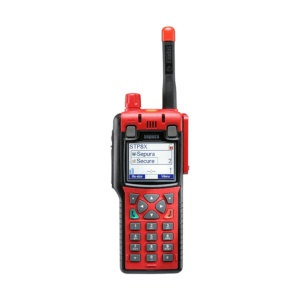
At Waves Middle East, we supply Damm infrastructure and Sepura handsets for TETRA deployments, and Kirisun handsets for DMR deployments.

What DMR is good for

DMR: Digital Mobile Radio, is a widely adopted standard suited to commercial and industrial operations that need reliable digital voice communication across a site or facility. It is cost-effective to deploy, straightforward to manage, and more than capable for most day-to-day operational environments. Kirisun radios are a practical, proven choice for organisations running DMR.

What TETRA adds

TETRA is built for environments where communication failure is not an option. It adds capabilities that DMR does not offer such as: simultaneous group calls at the press of a button, priority and pre-emption so critical users always get through, end-to-end encryption, and the ability for radios to communicate directly with each other even when network infrastructure is unavailable.

These capabilities matter in airports, oil and gas facilities, defence installations, and large-scale public safety operations.

Which one do you need?

If your operation requires day-to-day team coordination across a contained site, DMR is likely sufficient. If your environment involves large teams, hazardous conditions, security-sensitive communications, or scenarios where a failed call has serious consequences, TETRA is the right standard.

Not sure which applies to your situation? Speak to a Waves specialist and we will help you assess the right fit.

Categories
Industry Insights

Why Mission-Critical Operations Run on TETRA

When an airport needs to coordinate ground handlers, security, and emergency response simultaneously, or when a refinery operator needs to reach a team in a hazardous zone, the communication system they rely on has to work. Every time. Without exception.

That is the problem TETRA was designed to solve.

What TETRA is?

TETRA stands for Terrestrial Trunked Radio. It is a digital radio standard developed by the European Telecommunications Standards Institute (ETSI) for professional users in environments where communication cannot fail: emergency services, airports, oil and gas facilities, defence operations, and ports.

It is the most widely deployed professional mobile radio standard in the world, operating in over 130 countries.

What makes it different?

TETRA runs on dedicated, licensed spectrum, separate from commercial mobile networks. It does not drop during high-traffic events or emergencies. Key capabilities include:

– Instant group communication: one button press connects an entire team simultaneously

-Priority and pre-emption: critical users always get through, even on a congested network

-End-to-end encryption: communications cannot be intercepted

– Direct Mode Operation: radios communicate with each other even without network infrastructure

Why it matters in the Gulf?

Airports, offshore platforms, ports, and defence installations across the region share one requirement: communications that are always available, always secure, and fast enough to matter. TETRA was built for exactly these environments.

At Waves Middle East, we have been designing and deploying TETRA systems across the Gulf since 2000, working with Sepura for handsets and Damm for infrastructure: two of the most recognised names in critical communications globally.

Speak to our team about your communications requirements.